Leave A Message
Fill out the form with your requirements and quantities(PCB/ Component Sourcing/ PCBA), and upload your Gerber file & BOM list. We'll provide you with a free quote as soon as possible!
In the modern electronics manufacturing landscape, printed circuit board assemblies (PCBAs) are the foundational building blocks of nearly every technological device—from consumer electronics and automotive control units to industrial machinery, medical equipment, and aerospace systems. As electronic designs become increasingly compact, high-density and mission-critical, the demand for long-term durability, operational stability and resistance to environmental stressors has never been greater. At the heart of ensuring PCBA reliability lies automated conformal coating, commonly referred to as “three-proof paint” (moisture-proof, dust-proof, and corrosion-proof), a precision-engineered protective process that enhances assembly performance, extends product lifespan, and mitigates costly field failures. Unlike manual coating methods, automated conformal coating delivers unrivalled consistency, accuracy and scalability, making it an indispensable step in high-quality PCB assembly workflows.
1. What is Automated Conformal Coating?
Conformal coating is a thin, protective polymeric film applied to the surface of assembled PCBs that “conforms” to the contours of components, solder joints, and circuit traces. The term “three-proof” refers to its primary protective properties:moisture resistance, dust and particulate resistance, and corrosion resistance, with advanced formulations also offering protection against thermal shock, vibration, chemical exposure, and electrical insulation. Common coating materials include acrylics, silicones, polyurethanes, epoxy resins, and UV-curable compounds, each tailored to specific environmental and operational requirements.
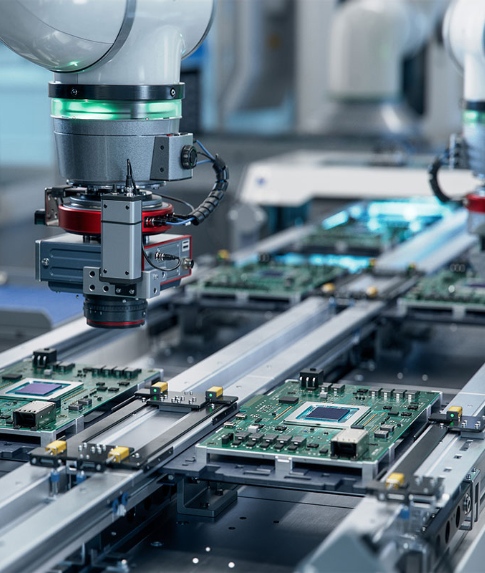
Automated conformal coating leverages robotic dispensing systems, precision spray nozzles, vision-guided positioning, and programmable logic control (PLC) to apply coating materials with micrometer-level accuracy. Unlike manual brushing, dipping, or hand-spraying, automated systems follow pre-programmed PCB layouts, targeting only critical areas while avoiding keep-out zones (e.g., connectors, test points, switches, and heat-sensitive components) that require unobstructed electrical contact or thermal dissipation. This selective, controlled application is the cornerstone of its value in modern PCB assembly, where even minor coating defects can compromise entire electronic assemblies.
2. Core Environmental Threats to Uncoated PCBs
Unprotected PCBs are extremely vulnerable to a range of environmental and operational stressors that cause premature failure, performance degradation, and safety hazards. Understanding these threats highlights why conformal coating is not a discretionary step, but a mandatory one for reliable electronics:
3. Limitations of Manual Conformal Coating Methods
Before the widespread adoption of automated systems, manual coating (brushing, dipping, hand-spraying) was the standard for PCB protection. However, these methods are riddled with inefficiencies, inconsistencies, and quality flaws that make them unsuitable for modern high-density, high-reliability PCB assembly:
In today’s electronics industry, where quality control, production speed, and cost efficiency are non-negotiable, manual conformal coating is a bottleneck that undermines the integrity of even the most well-designed PCBs. Automated systems eliminate these shortcomings by combining precision, repeatability, and automation into a seamless in-line assembly process.
4. Key Advantages of Automated Conformal Coating in PCB Assembly
Modern automated conformal coating systems are equipped with high-resolution vision guidance, multi-axis robotic arms, and precision nozzles that deliver positioning accuracy as tight as ±0.02mm (20μm). Engineers upload PCB Gerber files to the system’s software, defining exact coating zones and keep-out areas with pixel-perfect precision. This selective application ensures that only critical components and traces receive protection, while sensitive areas remain untouched—eliminating rework from miscoating and preserving full PCB functionality. For high-density PCBs with fine-pitch components (e.g., 0.4mm lead spacing), this level of accuracy is impossible to achieve manually, preventing coating bridging, short circuits, and component damage.
Automated systems maintain strict control over coating thickness (typically 20–200μm, per industry standards), flow rate, spray pattern, and application speed across every PCB in a production run. Unlike human operators, robots do not experience fatigue, distraction, or variability, ensuring that every assembly receives the same uniform, defect-free coating. This repeatability is critical for compliance with strict industry standards (e.g., IPC-CC-830 for conformal coating, ISO 9001, and automotive IATF 16949) and reduces the risk of field failures by minimizing weak points in the protective layer.
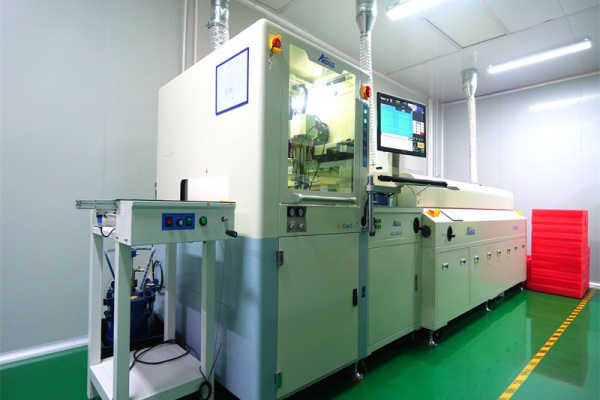
Automated conformal coating integrates seamlessly into in-line PCB assembly lines, working in tandem with pick-and-place machines, reflow ovens, and inspection systems to create a continuous, automated workflow. These systems can process hundreds of PCBs per hour, drastically reducing cycle times compared to manual methods. Additionally, automated systems eliminate the need for manual masking and demasking, cutting labor hours by up to 70% in high-volume production. For manufacturers producing mixed batches of PCBs, quick-programming software allows fast changeovers between different board designs, making automation ideal for both high-volume and high-mix assembly environments.
While automated coating systems require an initial capital investment, they deliver significant long-term cost savings through reduced labor costs, minimal material waste, and lower defect rates. Precise, targeted application reduces coating material waste by up to 50% compared to manual spraying, while fewer defects and reworks lower scrap rates and production delays. Fewer field failures also reduce warranty claims, product recalls, and brand reputation damage—costs that far outweigh the upfront investment in automation.
Automated systems enclose coating processes in sealed, ventilated chambers, minimizing operator exposure to VOCs and hazardous fumes. This creates a safer work environment and reduces the need for extensive PPE. Additionally, precise material application lowers VOC emissions, helping manufacturers comply with strict environmental regulations (e.g., RoHS, REACH) and reduce their carbon footprint.
Automated systems support a wide range of conformal coating materials, including UV-curable, moisture-curable, and thermal-curable compounds. UV-curable coatings, in particular, pair perfectly with automation: they cure instantly under UV light, preventing material bleed and ensuring fast throughput. This flexibility allows manufacturers to tailor coating solutions to specific applications—silicones for high-temperature resistance, polyurethanes for harsh chemical exposure, and acrylics for general-purpose protection.
5. Industry-Specific Applications of Automated Conformal Coating
Automated conformal coating is a universal requirement across electronics industries, with tailored use cases that highlight its critical role:
6. The Future of Automated Conformal Coating in PCB Assembly
As electronics continue to evolve—with smaller form factors, higher component densities, and more demanding environmental requirements—automated conformal coating will only grow in importance. Advancements in machine learning and artificial intelligence are already enhancing automated systems, enabling real-time adjustments to coating parameters, automatic defect detection, and predictive maintenance. Additionally, the rise of eco-friendly, low-VOC coating materials and fully integrated smart factory systems will make automated coating even more efficient, sustainable, and indispensable for PCB assembly.
7. Conclusion
Automated conformal coating (three-proof paint) is far more than a secondary step in PCB assembly—it is a critical reliability enabler that protects electronic assemblies from environmental damage, ensures consistent performance, and drives manufacturing efficiency. In an industry where quality, durability, and cost control define success, manual coating methods cannot compete with the precision, repeatability, and scalability of automated systems. For manufacturers, investing in automated conformal coating is not just a choice; it is a necessity to deliver high-quality, long-lasting electronic products that meet global industry standards and exceed customer expectations.
By integrating automated conformal coating into PCB assembly workflows, manufacturers can minimize failures, reduce costs, and build a reputation for uncompromising quality—securing their place in the competitive global electronics market.

We are committed to building a world-leading brand in circuit board assembly services, delivering the most reliable products and support to our customers. Our goal is to set a benchmark in the industry and actively contribute to the advancement of the electronics sector.



Our hours
24H


 IPv6 network supported